Detailed comparison of properties, uses and performance
Chilean, French and Chinese sphagnum all belong to the Sphagnum genus, but their growing conditions, properties and uses differ significantly.
Chilean sphagnum (Sphagnum magellanicum) grows in the vast peatlands of Patagonia, in a sub-Antarctic oceanic climate. Originally from New Zealand, it colonised South America via wind and ocean currents.
Its long fibers, blonde to light beige in colour, offer superior structure. Harvested under Decree No. 25 (good harvesting practices), it is dried to 96% dry matter, optimising the volume-to-weight ratio.
French sphagnum comes mainly from peatlands in the Massif Central, Brittany and the Landes. Dominant species are Sphagnum palustre, S. papillosum and S. capillifolium. It is harvested in protected areas where volumes are limited.
Its fibers are generally shorter and darker. It is often sold fresh (living) or slightly dried, making it heavier and less concentrated per kilogram.
Chinese sphagnum is not a single species. Chinese species are numerous and most often mixed at harvest.
The most common are Sphagnum palustre, Sphagnum fimbriatum and Sphagnum squarrosum.
| Criterion | Chilean sphagnum | European sphagnum (France / Jura / Nordic countries) | Chinese sphagnum |
|---|---|---|---|
| Espèce principale | S. magellanicum | S. palustre, S. papillosum | S. palustre, S. fimbriatum, S. squarrosum (mélange) |
| Origine géographique | Patagonie, Sud du Chili | Massif Central, Bretagne, Landes, Jura, pays nordiques | Guizhou (≈80% de la production nationale), Yunnan — plus de 2 000 m d'altitude |
| Longueur des fibres | Longues (8-16 cm) — 85% > 8 mm | Courtes à moyennes (2-5 cm) | Courtes, fibres fragiles |
| Couleur | Blonde / Beige clair | Brun foncé à verdâtre | — |
| Matière sèche | 96% | 40-70% | — |
| Matière organique | 99% | 85-95% | — |
| pH | 5.0 | 4.0 - 5.5 | Élevé et variable |
| Conductivité électrique | 0.72 mS/m (très faible) | Variable (0.5 - 2.0 mS/m) | Élevée — accumulation de sels |
| Rétention d'eau (volume) | 51% | 30-45% | — |
| Rétention d'eau (masse) | 2380% | 800-1500% | — |
| Rétention d'air | 67% | 40-55% | Faible une fois tassée |
| Porosité | 93% | 70-85% | — |
| Densité apparente | 22 kg/m³ (ultra-légère) | 50-120 kg/m³ | — |
| Volume / kg | 80 litres | 20-40 litres | — |
| Absorption (x poids sec) | 20x | 10-15x | — |
| Contaminants | Zéro matière non-compostable | Variable | Débris fréquents — décomposition rapide (9-12 mois) |
| Métaux lourds | Tous < Classe A (NCh 2880) | Variable selon site | — |
| Agriculture biologique | CE 834/2007 | Selon fournisseur | Non documentée |
| Norme substrat | NF U 44-551 | Variable | Non documentée |
| Réglementation récolte | Décret N°25 — Plan de récolte SAG | Zones Natura 2000 (limitée) | Culture en rizière d'altitude, récolte annuelle |
| Disponibilité | Toute l'année, volumes importants | Limitée, saisonnière | Volumes importants, entrée de gamme |
| Formats disponibles | 50g à 5kg (6 formats) | Vrac, sacs petits formats | — |
One origin, three distinct grades. Fiber length, colour and impurity level decide what each one is used for.
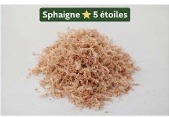
The most sought-after grade, recognisable by its lighter colour. Its long fibers, 8 to 16 cm, make it the recommended — and usually required — standard for orchid production.
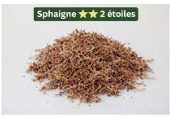
Shorter fiber and a darker colour. Used to improve substrates and as a soil conditioner: golf course construction, hanging baskets and general gardening.
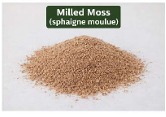
A byproduct of moss cleaning, used as a soil conditioner for a range of crops, with excellent results on blueberry. It improves the aeration and water retention of the soil or substrate.
| Criterion | 5-Star Sphagnum | 2-Star Sphagnum | Milled Moss |
|---|---|---|---|
| Fiber length | 8 to 16 cm | 3 to 6 cm | Milled (no long fiber) |
| Colour | Light beige | Light gray (tinted) | Light to dark brown |
| Impurities | ± 1% | ± 1.7% | < 2% |
| Indicative price | €35 to €40 / kg | €20 to €25 / kg | €3 to €5 / kg |
Note: prices vary widely from one grade to the next, even at identical Chilean origin. These figures are indicative, excluding freight and market variation.
Our long fibers measure 8 to 16 cm, offering superior structure, better aeration and slower decomposition than short fibers.
1 kg yields 80 liters of substrate (vs 20-40 L for French). At 96% dry matter, you pay for the product, not water.
2,380% water retention by mass — far superior to French sphagnum. Significantly reduces watering frequency.
Density of only 22 kg/m³ — ideal for green walls, hanging baskets and any weight-critical application.
Zero non-compostable material. Heavy metals well below Class A thresholds. Analysed by AGROLAB Chile.
Regular supply year-round, in 6 standard sizes. No seasonal shortages unlike European sources.
Its long fibers withstand mechanical stress far better than short fibers, which break down much faster. Chilean sphagnum is virtually rot-proof — decisive for green walls, where the substrate is under constant mechanical load.
Chilean sphagnum naturally secretes a powerful preservative polysaccharide whose antibacterial activity helps the plant resist disease and parasites. Historically used for antiseptic wound dressings, it is increasingly used today to preserve fresh produce such as fruit and fish.
| Use | Chilean sphagnum | European sphagnum (France / Jura / Nordic countries) | Chinese sphagnum |
|---|---|---|---|
| Terrarium tropical | Excellent — fibres longues, esthétique blonde | Possible mais fibres courtes | Possible — fibres courtes |
| Orchidées & épiphytes | Idéal — aération et drainage optimaux | Acceptable | Usage courant en semis et jeunes plants |
| Plantes carnivores | Substrat de référence — conductivité très faible, pH stable | Convient, fibres plus courtes | Conductivité élevée — sels mal tolérés |
| Plantes acidophiles** | Idéal — pH 5,0 stable, allège et acidifie le substrat | Bien — pH acide | pH élevé et variable |
| Cactées, succulentes | En mélange drainant uniquement, jamais seule | Trop rétentrice, fibres tassantes | Trop rétentrice, sels |
| Plantes exotiques*** | Excellent — aroïdées et épiphytes, aération et humidité | Acceptable | Possible — rempotage plus fréquent |
| Myrtilles | Très bon — moulue en amendement acidifiant | Usage local, volumes limités | Usage courant en pépinière |
| Mur végétal | Parfait — ultra légère (22 kg/m³) | Trop lourde | Structure trop faible |
| Bouturage | Excellent — milieu stérile, pH stable | Bien | Stérilisation préalable recommandée |
| Paillage | Très bon — décomposition lente | Usage local | Correct — décomposition rapide |
| Kokedama* | Idéal — fibres longues faciles à travailler | Possible | Fibres trop courtes pour la tenue |
| Hydroponie / aquaponie | Excellent substrat inerte, pH stable | Peu adaptée | pH et conductivité trop élevés |
| Pépinière professionnelle | Format 5 kg pro, approvisionnement garanti | Volumes insuffisants | Volumes importants, entrée de gamme |
| Performances antibactériennes dans la durée | Active durablement — fibres quasi imputrescibles (2-3 ans) | Active, s'atténue avec la dégradation des fibres courtes | Dégradée rapidement (9-12 mois) |
* : plante d'intérieur élégante présentée dans une sphère de mousse naturelle.
** : érables, magnolias, skimmia, piéris/andromèdes, rhododendrons, azalées du Japon, camélias, hortensias, etc.
*** : Alocasia, Monstera, Tillandsia, Strelitzia, bananier, palmier de Kentia, Anthurium, etc.
The colour depends on the species and degree of decomposition. Sphagnum magellanicum from Chile is harvested fresh and dried quickly, preserving its natural blonde hue. French sphagnum, often sold partially decomposed, takes on a darker tone.
Yes. Sphagnum magellanicum is a circum-sub-Antarctic species found in New Zealand, South America and certain sub-Antarctic islands. It colonised Patagonia via natural dispersal (winds and ocean currents) thousands of years ago.
Yes. Harvesting is regulated by Decree No. 25 of the Chilean Ministry of Agriculture (amended in 2019). Harvesters must: leave at least 5 cm of living moss, keep 30% of each area unharvested, obtain SAG certification (Servicio Agrícola y Ganadero), and submit a detailed harvest plan.
Yes. Our sphagnum is approved for organic farming under European regulation EU 834/2007. It also complies with the NF U 44-551 standard for growing media.
1 kg of Chilean sphagnum yields approximately 80 liters of substrate. For French sphagnum, the yield is 20 to 40 liters per kilogram due to its higher water content and shorter fibers.
Soak the product in water for a few minutes then use it as a substrate. 150 g of dry product is equivalent to 3 kg once moistened. Can be used pure or mixed with other substrates depending on the application.
L'Or Vert is a French sphagnum moss importer and distributor. We import long fiber sphagnum moss directly from Chilean Patagonia and hold stock in Paris, shipping sphagnum moss Europe-wide. We supply resellers, garden centres, growers, orchid nurseries and pet shops.
Yes. As a wholesale sphagnum moss supplier we serve professional buyers: sphagnum moss wholesale pricing, reseller terms and formats up to 5 kg. Larger volumes ship by the pallet — a pallet of bags. Contact us for quantities and trade rates.
Long fiber Chilean sphagnum moss is the reference substrate for repotting orchids: it holds up to 20 times its weight in water while staying aerated, which limits root asphyxiation. Orchid sphagnum moss is our highest-volume line.
Yes. Our moss contains no additives or chemical treatment, so terrarium sphagnum moss is safe in direct contact with reptiles and amphibians. It is also used as kokedama moss, as a substrate for carnivorous plants and as topdressing for bonsai.